
OKCLEAR STORIES · LIVING TOGETHER
You love your cat. Why does home still feel so hard?
For many cat-loving households, the real challenge is not finding one more product. It is building a routine that manages cat allergens without guilt, distance or an unsustainable amount of work.
OKCLEAR · 2026.09.05 · 22 min read

See if this feels familiarRead the research brief
Living closer should not begin with giving up closeness
THE PROBLEM IS NOT A LACK OF EFFORT
You may already be doing a lot. The actions simply have not been connected into one system.
You wash bedding, vacuum, wipe the sofa, run an air purifier and perhaps keep the cat out of the bedroom. When discomfort returns, it is easy to conclude that the home is still not clean enough—or to ask the far more painful question: should I have a cat at all?
The deeper problem is often not effort. Cat allergens do not stay only on visible hair. They move from the cat to the coat, dander and particles, then into fabrics, furniture and air before contact and movement bring them back into daily living zones. This is a replenishing pathway, not a stain that disappears after one deep clean.2
That makes “what should I buy?” the last question, not the first. Before it come four decisions: where the cat spends time, who has the most contact, which actions already happen, and how much additional effort the household can realistically carry. Only then can products become a usable pathway rather than a collection of items.
01 · WHERE BUYERS GET STUCK
People are not buying one more pet product. They are trying to solve four unmet needs.

PAIN 01
I want closeness, not another closed door
Beds, sofas and laps are where the bond lives—and where coat and fabric repeatedly meet. The problem is not loving the cat too much. High-contact moments simply need a gentler management plan.
WHAT THIS LOOKS LIKE : The cat sleeps on the bed or sofa; cuddling and grooming happen daily; the household will not sustain a permanent no-entry rule.
COMMON TRAP : Treating total separation as the only answer, then abandoning the plan when guilt and daily reality make it impossible.
FIRST MOVE : Attach one source action to daily feeding, then pair one coat-care action with the household's most frequent moment of closeness.
WHEN TO ADD A LAYER : Add the home layer when bedding and cushions remain the dominant touchpoints; there is no need to address every room on day one.
PAIN 02
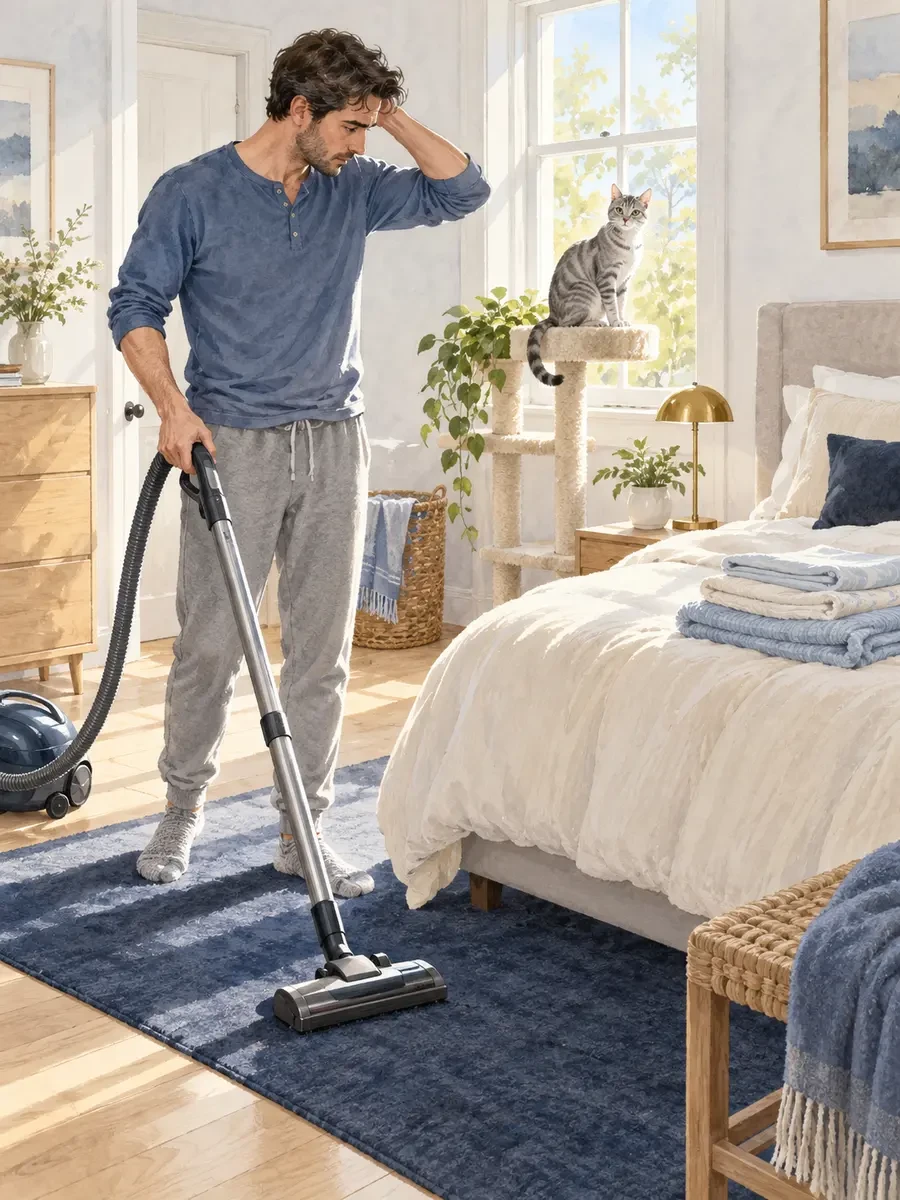
I keep cleaning, but never know what it changes
Visible hair can be removed, while proteins such as Fel d 1 can also travel on smaller particles and settle in dust and fabrics. Without an exposure map, more cleaning can simply create more fatigue.5
WHAT THIS LOOKS LIKE : Floors look clean, yet bedding or sofas still feel problematic; vacuuming is frequent, but priority zones are unclear.
COMMON TRAP : Equating “no visible hair” with “the pathway is controlled” while coat, soft furnishings, cat beds and litter zones keep replenishing it.
FIRST MOVE : Map the cat's five most-used locations and choose only the two highest-contact zones as this week's priority.
WHEN TO ADD A LAYER : Once high-contact zones are stable, expand to air, lower-frequency textiles and edges instead of opening every front at once.

PAIN 03
I own several products, but not a coherent routine
Food, topper, wiping, shampoo, spray and litter do not perform the same job. They belong to different source–coat–home layers. Define the role first, then decide what belongs in the routine.
WHAT THIS LOOKS LIKE : Several products already sit in the cupboard; use is irregular; comparisons default to price, scent or packaging instead of purpose.
COMMON TRAP : Adding products at the same time without recording the node each one addresses, leaving no way to know which action deserves to stay.
FIRST MOVE : Label every current product source, coat or home. Keep one easiest-to-execute lead action in each layer.
WHEN TO ADD A LAYER : Add only when a clearly identified node remains uncovered—not simply to make the routine look more complete.
PAIN 04
I need a routine I can keep—not a one-week reset
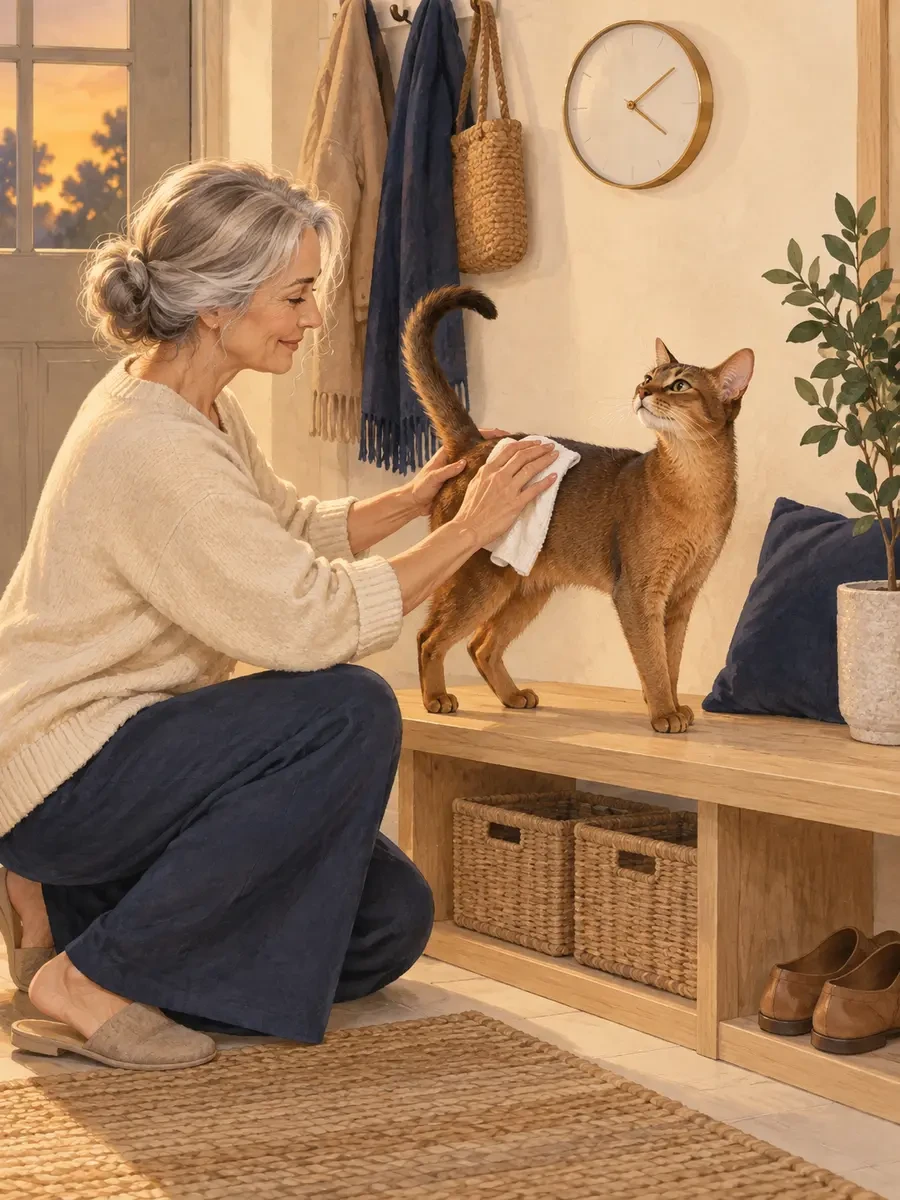
A useful household plan must be low-friction: attached to feeding, affection, litter care and laundry rather than a separate daily ceremony. Adherence is not an extra; it is part of the design.
WHAT THIS LOOKS LIKE : A major clean happens on weekends and little happens on workdays; roles are unclear; the plan stops as soon as life gets busy.
COMMON TRAP : Replacing continuity with intensity—doing everything in week one, then stopping because the time cost is too high.
FIRST MOVE : Fix one daily anchor and one weekly anchor for two weeks. Do not aim for a complete system yet.
WHEN TO ADD A LAYER : Add the next layer only when the current actions happen without reminders, and bind every new action to an existing event.
02 · DEFINE THE REAL JOB
The household does not need less visible hair alone. It needs a way to manage a recurring source–coat–home pathway.
Hair is often better understood as a carrier. Grooming transfers saliva-derived proteins to the coat, after which hair, dander and particles enter the home. Published work has detected airborne Fel d 1 across particle sizes, while household dust may take months to decline substantially even after the cat is removed.2 3
The job therefore changes: The question is not how much hair was removed today. It is whether repeated input and high-contact nodes can be managed without sacrificing closeness.
01CAT
Salivary and sebaceous sources
→
02COAT
Transfer through grooming
→
03HOME
Fabrics, air and surfaces
↺

FROM CAT TO SHARED HOME
Cat allergens do not remain only on visible hair. Grooming, coat contact and deposition on fabrics keep the pathway moving.
01Not remove the cat from life
Preserve closeness
Bring high-contact moments into the plan so bedrooms, sofas and cuddling are not treated as zones that must simply be surrendered.
02Not add endless cleaning
Know what each action changes
Give every action a defined node and a clear source, coat or home role.
03Not only remove fallen hair
Reduce repeated input
Place a management point at the source, during coat transfer and after deposition in the home.
04Not perform one heroic reset
Stay consistent
Attach actions to feeding, closeness, litter care and laundry rather than building a separate ceremony.
03 · WHY ONE-POINT SOLUTIONS LEAVE GAPS
Existing products can be useful. The limitation is that most address only one part of the pathway.
Choosing a solution requires more than one isolated metric. It also requires knowing whether the action covers source, coat or home—and whether uncovered nodes continue to replenish the pathway.
ONE USEFUL STEP IS NOT FULL-PATH COVERAGE
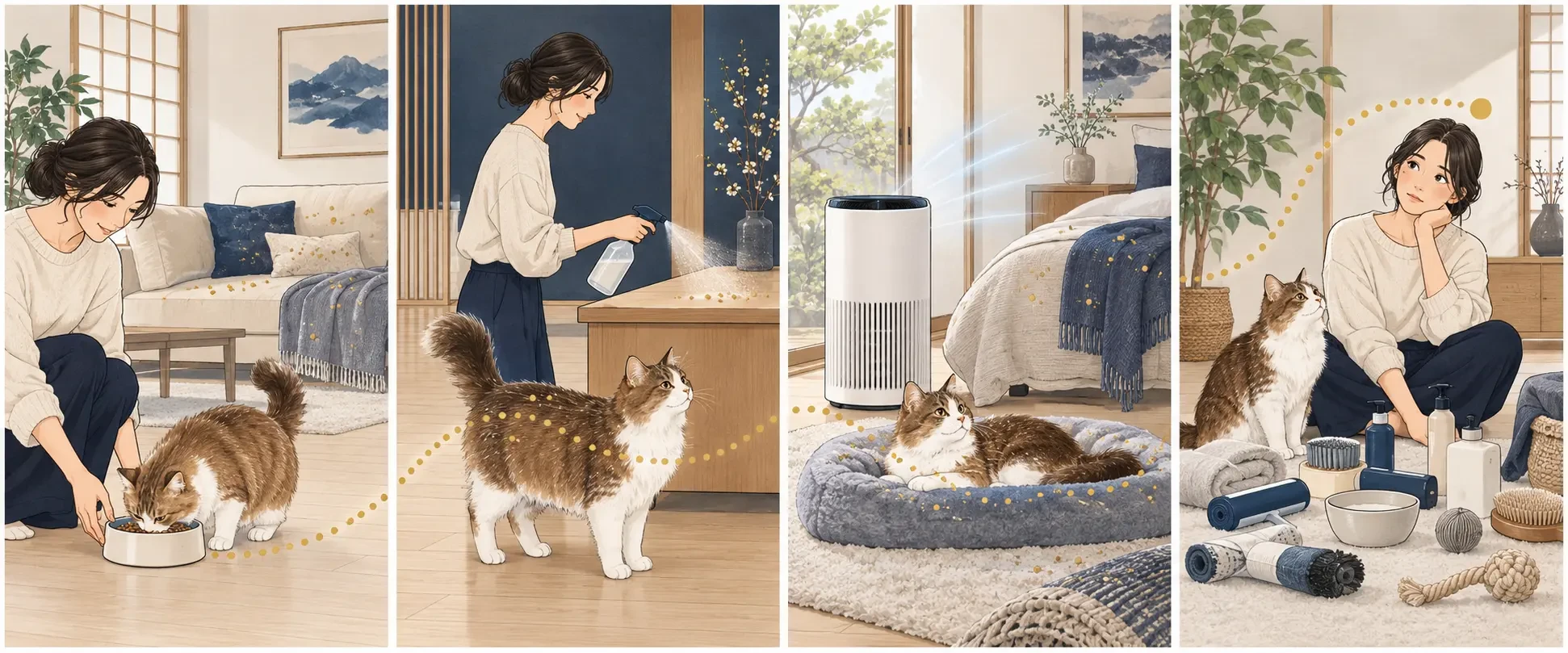
Managing only source, coat or home can leave other nodes replenishing the pathway. The key is knowing both what each measure does and what it does not cover.
WHAT IT CAN DO
Embed an intervention in daily feeding and act at the cat-source layer.
WHY A GAP CAN REMAIN
Published anti-Fel d 1 IgY work focuses mainly on Fel d 1 and reports an average reduction in active Fel d 1 on hair beginning in Week 3; current specialist supplements also commonly center on Fel d 1. These approaches do not directly manage every node already present on coat, bedding and the indoor environment.4 68
WHAT IT CAN DO
Address selected surfaces or airborne situations after allergen has entered the home.
WHY A GAP CAN REMAIN
It acts at the back of the pathway. If source and coat keep replenishing the environment, the action must keep repeating. Current specialist sprays also commonly center their claim on Fel d 1.7
WHAT IT CAN DO
Filter particles within a defined air volume and supplement ventilation and source control.
WHY A GAP CAN REMAIN
It is not the same as managing the cat source, direct coat contact or all allergen already settled in fabrics. The EPA likewise positions filtration as a supplement to source control and ventilation.9
WHAT IT CAN DO
Put separate feeding, cleaning and grooming categories into the same home.
WHY A GAP CAN REMAIN
Instructions remain independent, with no shared node map, sequence or household ownership. More products do not automatically create more complete coverage; they can create more execution cost.
04 · WHY OKCLEAR IS A BETTER FIT
Not one more isolated product—a shared map connecting the pain, the exposure node and the product role.
For households that want closeness while balancing coverage, decision speed and adherence, OKCLEAR provides a fuller, composable daily pathway that can still begin with one priority node.
ONE SYSTEM, THREE LAYERS
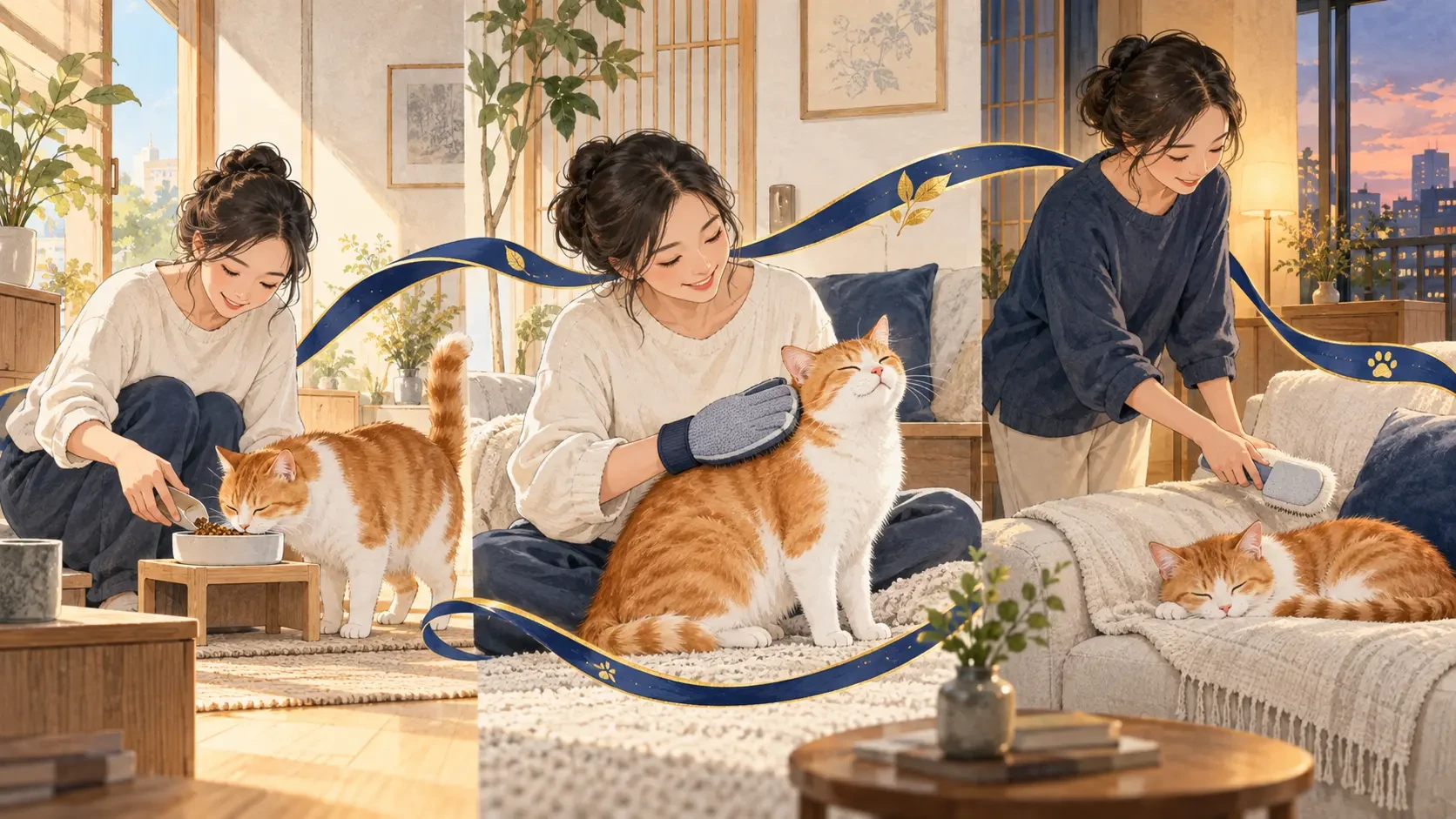
Daily feeding addresses source, frequent and periodic care connect to coat, and fabrics, surfaces and the litter zone extend the routine into home; seven products each serve a defined touchpoint.
DECISIONCOMMON ONE-POINT APPROACHOKCLEAR
Problem definition
Visible hair, one protein or one room
Fel d 1–8 R&D map + the full exposure pathway
Scene coverage
Usually one of source, coat or home
Composable source + coat + home layers
Product relationship
Separate categories with separate instructions
Seven products assigned to nodes on one shared pathway
Starting logic
Choose a product first, then see whether it helps
Find the largest friction first, then select the smallest workable combination
Timing language
Published functional-diet evidence reports haircoat changes from Week 3
Relevant SKU testing observed target-indicator change as early as Day 1
01A broader definition
Start from Fel d 1–81
Fel d 1 matters, but it is not the entire cat-allergen family. OKCLEAR uses Fel d 1–8 as a broader R&D and patent map, reducing the blind spot created when “cat allergen” is treated as one protein.
02A fuller pathway
Link source–coat–home
Seven products enter feeding, frequent coat wiping, periodic coat care, fabrics and surfaces, and the litter zone. They are not seven islands; they are tools assigned to one transmission pathway.
03Earlier decision feedback
As early as Day 1 in relevant SKU tests6
Under defined OKCLEAR test conditions for the relevant product, a target-allergen-related indicator change was observed as early as one day. Published anti-Fel d 1 IgY diet research reports haircoat changes beginning in Week 3. This is not a head-to-head clinical comparison and does not mean human symptoms improve in one day.
04A more flexible entry
Solve the largest friction, then add layers
A household does not need every product at once. Begin with one daily anchor or one high-contact scene, and add another layer only when a clearly identified node remains uncovered.
05 · ONE-MINUTE HOUSEHOLD CHECK
Decide whether you need one product—or a pathway connecting several recurring nodes.
This is not a medical diagnosis or allergy-risk score. Use the four dimensions only to plan household actions, counting each statement that fits.
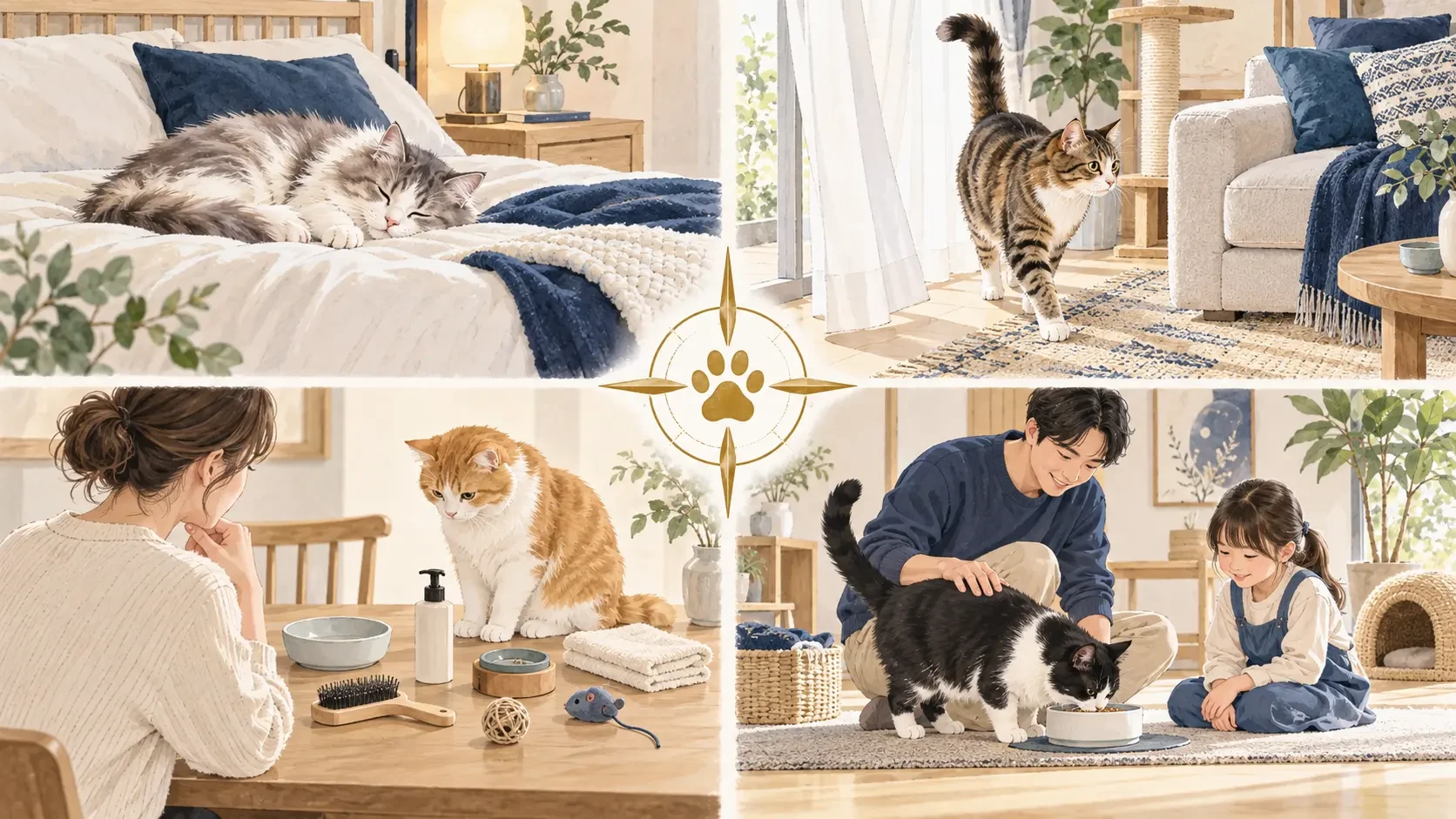
THE HOUSEHOLD DEFINES THE START
The cat's movement, patterns of closeness, fabric density and existing habits together determine which node should come first.
How close is daily life?
The cat enters the bedroom daily or regularly rests on sofas and bedding.
Cuddling, face contact, grooming or lap time happens every day.
Where does the cat spend time?
The home contains several rugs, fabric sofas, curtains, cat beds or plush textiles.
Cleaning is frequent, but decisions are driven mainly by visible hair.
Do current actions have roles?
More than two products are in use, yet their source, coat or home roles are unclear.
Household roles for feeding, coat care and textiles are not fixed.
Can the household sustain them?
Strict separation or intensive cleaning was tried before but stopped within two weeks.
The goal is to preserve closeness while keeping the routine sustainable.
010–2 boxes
Build one anchor
Choose the easiest repeatable action: a source step at feeding or one fixed coat-care moment. Keep it for two weeks.
023–5 boxes
Connect two layers
Begin with source + coat or coat + home, and manage only the two highest-contact locations to prevent routine overload.
036–8 boxes
Prioritize before combining
Map high-contact zones and assign household roles, then build daily, after-contact and weekly rhythms instead of activating every product.
06 · A ROUTINE DESIGNED TO LAST
Do not turn home into a laboratory. Attach management to a day that already exists.
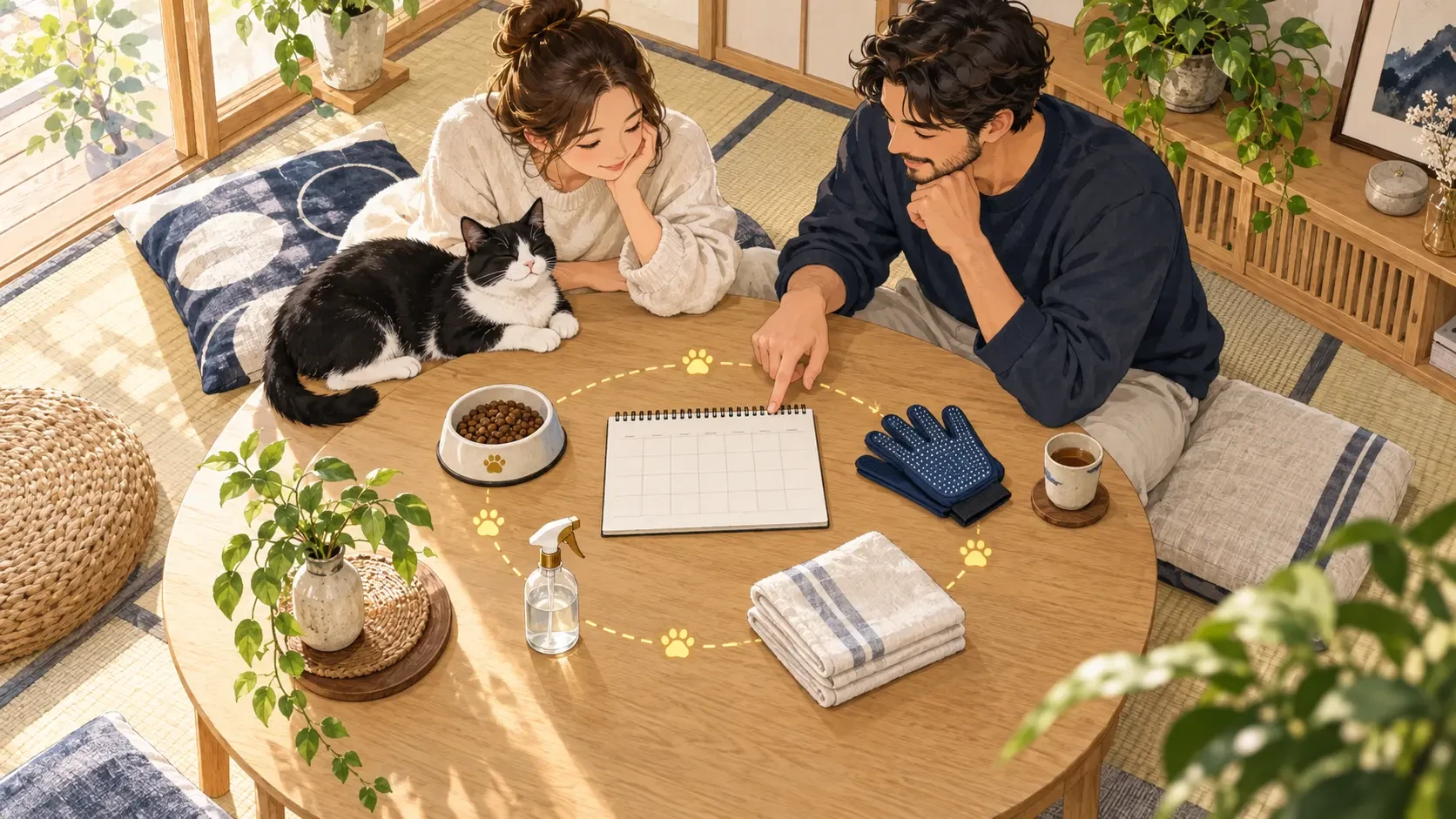
MAKE MANAGEMENT PART OF EXISTING HABITS
Begin with one daily anchor and one weekly anchor. Actions that repeat naturally are the ones most likely to create lasting value.
MORNING01
Start at the source during feeding
Complete baked cat food or cat allergen neutralizing powder integrates source management into an accepted daily habit.
AFTER CLOSENESS02
Wipe high-contact coat areas
A rinse-free cleaning glove supports quick coat care after cuddling, grooming or returning home—without turning every contact into a bath.
DAILY TIDY-UP03
Address the cat’s frequent touchpoints
Use the environmental spray on suitable fabrics or surfaces as directed, and include the litter-box area instead of focusing only on the living-room floor.
PERIODIC CARE04
Use shampoo for deeper coat care
Schedule washing according to the cat’s tolerance and product directions. Separate periodic washing from frequent wiping so each action has a realistic role.
The logic is not “do more.” It is “give every action one clear job.”
07 · OKCLEAR · SOURCE–COAT–HOME
Seven products are not seven islands. They are tools assigned to three layers.
OKCLEAR uses Fel d 1–8 as a broader R&D map and develops IgY and other product routes for different exposure points. Fel d 1–8 are eight distinct domestic-cat allergen components—not eight versions of one ingredient. Product conclusions remain specific to each SKU’s formulation, testing and documentation.1
Daily
Source
Complete baked cat food · Cat Allergen-Reducing Powder
Build the first action into feeding instead of redesigning the cat’s day.
Frequent wipe + periodic wash
Coat
Rinse-free cleaning glove · Cat-allergen care shampoo
Address the coat that is hugged, touched and carried onto sofas and bedding.
By touchpoint
Home
Cat-allergen care spray · Cassava cat litter
Extend the routine to textiles, hard surfaces and the litter-box area.
IF YOU CARE MOST ABOUT
Keeping the cat’s day familiar
Begin with an action embedded in feeding or gentle coat care to reduce friction.
IF YOUR BIGGEST FRICTION IS
Sofas, bedding and high-contact zones
Connect coat and home actions instead of stopping at one-off surface cleaning.
IF YOU WORRY MOST ABOUT
Not being able to keep it up
Fix one daily anchor and one weekly anchor first. Expand only after they feel normal.
Products are organized across source–coat–home. A target-allergen indicator change should be understood under the defined test conditions for the applicable product; it is not the same as human symptom improvement and is not a diagnosis or treatment claim.
THE REAL OUTCOME IS BIGGER THAN A PRODUCT
It is a home that no longer has to renegotiate whether closeness is allowed.
Good cat-allergen management should not turn the cat into the problem or add more guilt to the owner. It should translate complex science into clear household actions: where to begin, what to address next, which expectations are reasonable and which boundaries must stay explicit.
That is the role OKCLEAR is designed to play: not a universal shortcut, but a source–coat–home pathway that an ordinary household can understand, carry out and continue.
FAQ
Five questions worth asking before you buy
Clear boundaries protect people, cats and long-term trust.
Is OKCLEAR a medicine?
No. OKCLEAR is a cat-allergen management brand for pets and the shared home. It is not intended to diagnose, treat or replace human medication or professional medical advice.
Do I need to buy all seven products at once?
No. Source–coat–home is a management map, not a mandatory shopping list. Start with the action that fits most naturally into your routine, then add touchpoints according to where your cat spends time and where contact occurs.
Does “as early as Day 1” mean human symptoms improve in one day?
No. It refers only to a target-allergen indicator change observed as early as one day under defined OKCLEAR product test conditions. An indicator change is not the same as symptom improvement. Refer to the evidence for the specific SKU.
Do I still need cleaning and ventilation?
Yes. A product portfolio addresses selected nodes; it does not make cleaning, air management or medical advice unnecessary. Layered measures have different boundaries and better reflect a real household exposure pathway.
What if someone at home already has significant symptoms?
Consult a physician or allergy specialist for proper assessment. Household allergen management may be part of the living environment, but it does not replace diagnosis or treatment.
WANT THE EVIDENCE BEHIND THE ROUTINE?
Continue with the OKCLEAR cat-allergen research brief
Explore the full audit of Fel d 1–8, airborne exposure, IgY, environmental controls, human evidence and product-validation boundaries.
REFERENCES
- WHO/IUIS Allergen Nomenclature — Felis domesticus allergens Fel d 1–8
- Luczynska et al. Airborne concentrations and particle size distribution of Fel d 1. Am Rev Respir Dis. 1990.
- Wood et al. The effect of cat removal on allergen content in household dust. J Allergy Clin Immunol. 1989.
- Satyaraj et al. Reduction of active Fel d 1 from cats using an anti-Fel d 1 egg IgY antibody. Immun Inflamm Dis. 2019.
- Portnoy et al. Environmental assessment and exposure control: a practice parameter—furry animals. 2012.
- Purina Institute — Anti-Fel d 1 IgY: active Fel d 1 reductions in saliva and hair beginning in Week 3.
- PacaGen — Cat Allergen Neutralizing Spray: an environmental product targeting airborne Fel d 1.
- PacaGen — Cat Allergen Reducing Supplement: a source-oriented product targeting Fel d 1.
- U.S. EPA — Air cleaners and filters supplement source control and ventilation; they do not remove all indoor pollutants.
LIVE CLOSER · MANAGE SMARTER
Start with the action you can keep
Explore the OKCLEAR portfolio or contact our team about products, channels and global partnerships.
OKCLEAR
Questions about the evidence or the products?
Email opens in your own mail app. We reply with materials according to the project scope.